How is the local media in Van covering the war that began with the U.S. and Israel’s attack on neighboring Iran?
According to the Press Advertising Agency’s lists, there are 18 online news sites operating in Van, and only eight of them also have print editions. There are three additional newspapers published in the city’s districts, but they do not have websites.
We examined seven of these news sites. It appears that war coverage relies more on official statements and news agency bulletins than on the observations of correspondents dispatched to the border 110 km away. Still, not all of the reporting is “desk-based.” In street interviews with Van residents, “fear of war” and “the war’s impact on people’s pockets” take center stage.
Van, which shares a 295-kilometer border with Iran, feels every development in its neighboring country acutely. The war launched by the U.S. and Israel on the night of February 28 plunged the city’s local media into a hectic news cycle.
We examined how news websites operating in Van covered the war and conveyed developments to their readers. For this, we selected news from six newspapers that also have websites and one news website that does not have a print edition.
It appears that the local media is focusing more on the potential effects of the war on Van’s economy, trade, and tourism than on the developments of the war itself. Headlines such as cross-border trade, activity at the Kapıköy Border Gate, a potential decline in tourism, and possible waves of migration are highlighted in many news stories.
FROM THE OFFICE, NOT THE BORDER
Most of the news relies on national news agencies rather than direct observation. It is noteworthy that media outlets located closest to the Kapıköy Border Crossing have not sent reporters to the border. On the other hand, the news is not entirely “desk-based” either.
Reports featuring street interviews that explore what the public thinks about the war are also being published. In these reports as well, concerns regarding the war’s impact on the city’s economy take center stage.
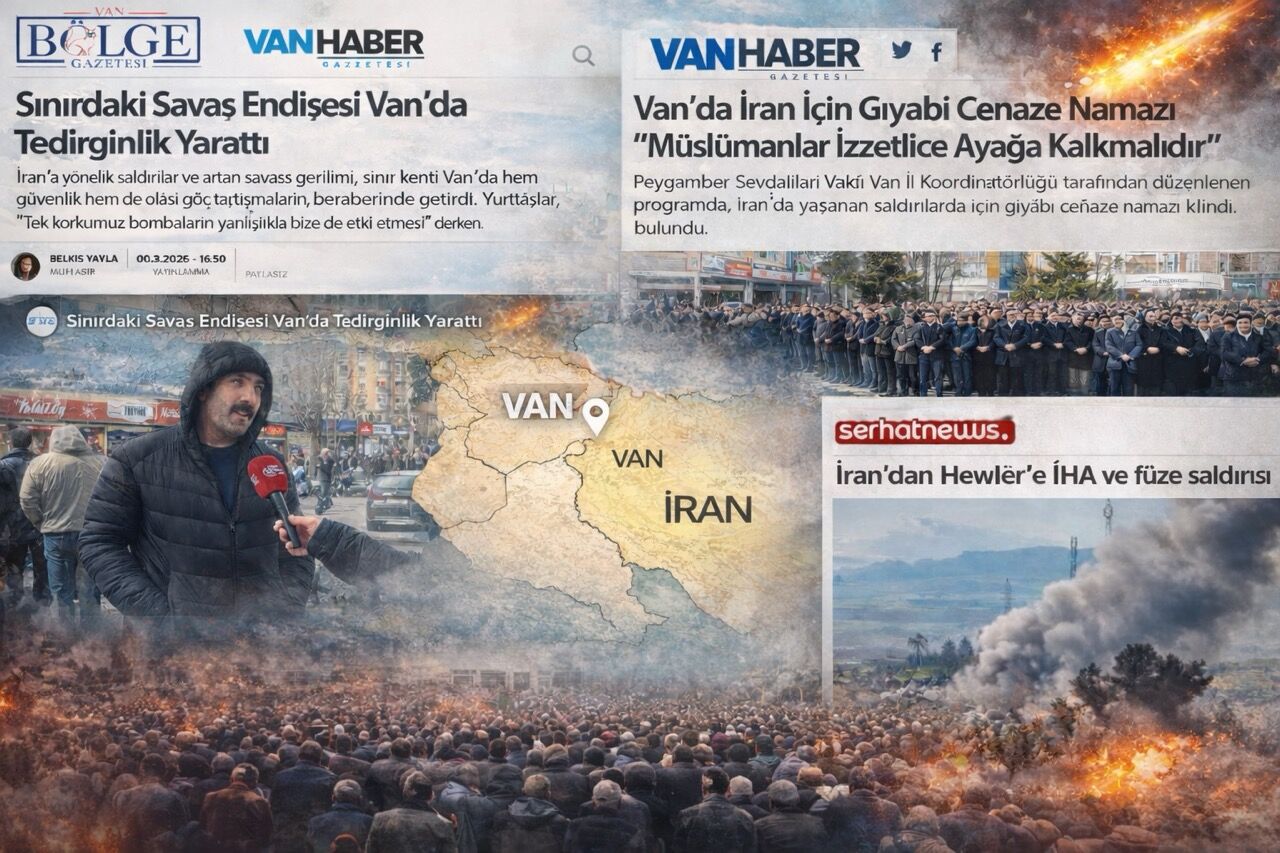
For example, the Van Bölge Gazetesi’s March 2 article titled “Fears of War at the Border Have Caused Anxiety in Van” addresses the fear of war among Van residents. In the lead paragraph of the article, which frequently uses the terms “concern” and “unease,” it states: “Citizens say, ‘Our only fear is that the bombs might accidentally hit us too,’ while shopkeepers say business has come to a standstill.” While the article does not provide detailed information on the latest developments in Iran, it merely refers to “attacks in Iran and rising tensions over the war.”
Another example comes from the Van Regional Newspaper. The articles titled “Ministry of National Defense Announces: Missile Fired from Iran Toward Turkey!” and “Erdoğan’s Statement on the ‘Intercepted Missile’: ‘We Never Leave Matters to Chance at the Border’” consist solely of official statements translated into news language. There is no space given to a reporter’s observations or the assessments of the public or experts on the subject. It is noted that the news story regarding the Ministry of National Defense’s statement was written at the ministry’s press office. Information indicates that the news story regarding President Recep Tayyip Erdoğan’s statements on the missile shot down in Turkish airspace was sourced from another online news site with no connection to Van.
The article published by Şehrivan Newspaper on the third day of the war under the headline “U.S./Israel-Iran War Hits Van Tourism!” contains remarks by Trade Minister Ömer Bolat regarding the mutual closure of the border crossing. The article titled “First Statement on the Missile Headed Toward Turkish Airspace from Iran!” also reports on a statement issued by the Iranian General Staff. The source of the statement claiming that the missile shot down in Turkish airspace was not launched from Iran is another online news site.
Van65 Haber’s articles titled “A Frightening Scenario for Van: How Would an Iran-U.S. Conflict Affect the City?” and “How Will Tensions in the Middle East Affect Van?” also examine the economic, social, and security issues Van could directly face as a result of the war.
Based on statements from the Van Chamber of Commerce and Industry, the articles report on border trade, migration flows, and expected developments in the energy markets. Van65 Haber’s article titled “Ballistic Missile Fired from Iran Destroyed in Mid-Air at the Hatay Border”, however, is based on official statements; it does not include on-the-ground observations or public opinion.
Van Haber Gazetesi’s article titled “Funeral Prayer in Absentia for Iran in Van: ‘Muslims Must Rise with Dignity’” reports on the public reaction. The article, covering the funeral prayer in absentia organized by the Prophet’s Lovers Foundation for those who lost their lives in Iran, is supported by detailed explanations and numerous photographs.
Another article published by the same organization under the headline “Death Toll in Iran Rises: Here’s the Number of Fatalities in 6 Days” is a report from the İhlas News Agency detailing the number of people killed and wounded in the war. Since it is an agency report, it is possible for it to appear under the same headline on local websites in other cities.
Serhat News’s “Drone and Missile Attacks from Iran on Hewlêr” report details the war’s impact on Erbil, the capital of Iraq’s Kurdistan Regional Government. The source of the story is the Mesopotamia Agency. The agency, in turn, based its report on a story by Rudaw. The statement, “The city of Hewlêr in the Federal Kurdistan Region is also a target of the attacks,” emphasizes that the war’s impact is not limited to Iran, Turkey, and certain Arab countries, but also includes northern Iraq.
Serhat News’s article “Bahçeli’s Warning on Iran and Reminder of Öcalan: Are You Aware That the Threat Is Approaching?”, on the other hand, highlights the rhetoric and domestic politics unfolding in Ankara rather than the war at the border. Instead of addressing the global and political causes of the event, the article presents strong statements and political commentary.
THERE ARE 21 MEDIA OUTLETS IN THE CITY
According to the Press Advertising Agency’s lists, 18 online news sites operate in Van, eight of which also publish print newspapers. Additionally, there are three more newspapers published in the city’s districts. This raises a new question: Despite having a relatively vibrant local press, why isn’t enough time and effort being devoted to news coverage?
Some newspaper owners interviewed attributed this to economic problems. They stated that they could not send reporters into the field, and that this situation severely limited the newspapers’ capacity to produce news. In particular, they said that a lack of financial resources and rising operating costs prevented active on-the-ground journalism.