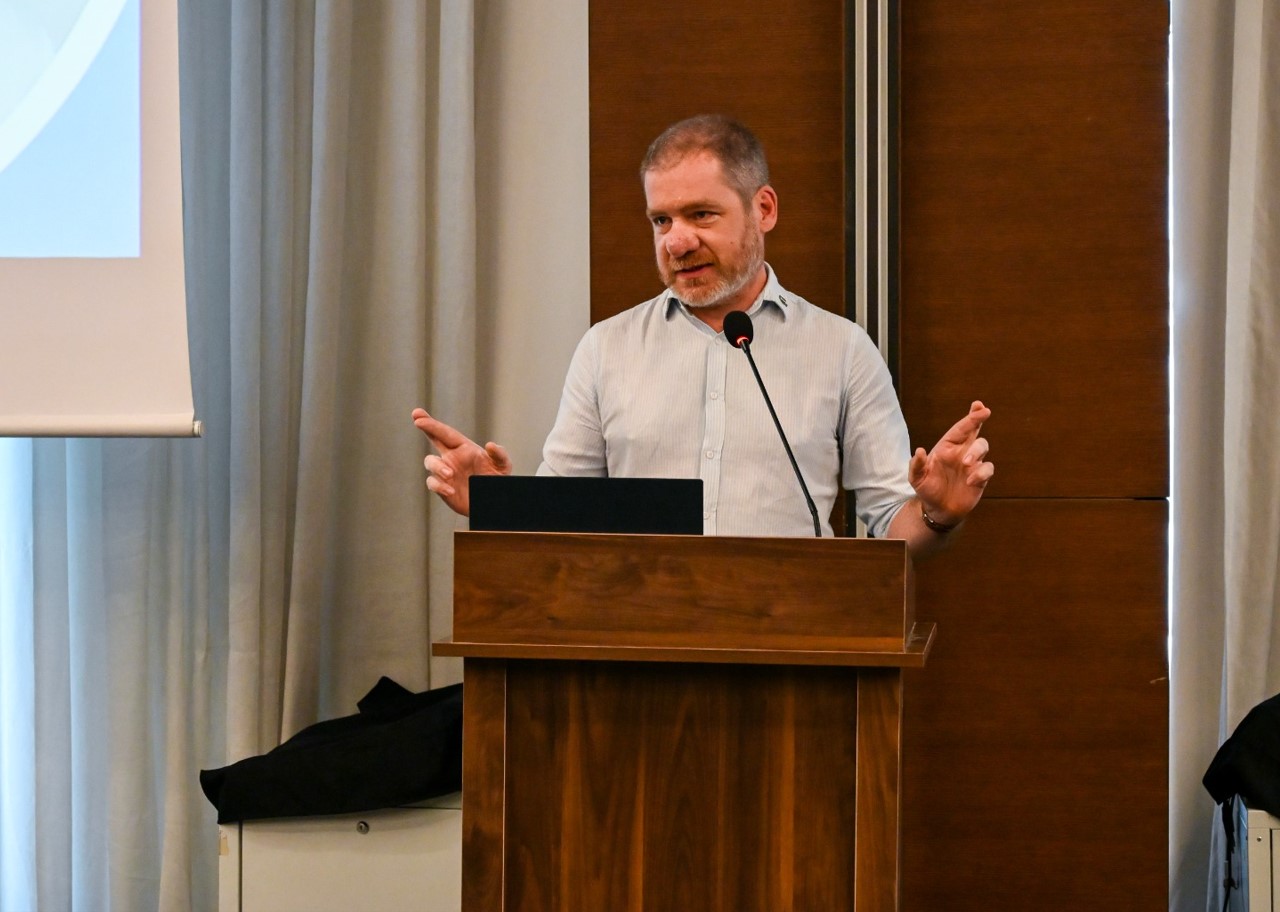
Hungarian journalist Marton Gergely was in Ankara last week to speak at the general assembly of the European Federation of Journalists (EFJ). We spoke with Gergely—who is also the Editor-in-Chief of the weekly news magazine HVG and President of the International Press Institute (IPI)—about the media landscape in Hungary following the end of Viktor Orbán’s 16-year rule.
Marton Gergely began his speech at the opening of the general assembly by describing the feeling of transitioning from an authoritarian regime to democracy overnight: “Divers need to stop and take a break several times as they rise from the depths to the surface to avoid decompression sickness. We, however, feel as if we’ve suddenly surfaced from meters below the water’s surface. We’re dazed.”
He is someone who likes to describe situations and emotions using metaphors. During his speech, he also compared public broadcasting under the Orbán era to a restaurant that constantly poisons its customers. When we met with him after the speech, that was our first question. The newly elected Peter Magyar had stated in the early days that he would shut down the public broadcaster, claiming the institution was beyond salvation. However, he did not do so. According to Gergely, he won’t do it either. In his view, the process will proceed by transforming the existing structure: “My prediction is that, rather than completely tearing down the kitchen and rebuilding it from scratch, an approach focused on cleaning it up first will be adopted.”
Although Prime Minister Magyar speaks of democracy and freedoms at every opportunity, his interesting practices have drawn attention. According to Gergely, Magyar places great importance on communicating directly not only with his own constituents but with the entire Hungarian people. For example, during the introduction of new ministers, he didn’t leave the task of asking questions to journalists but took it upon himself. He held a discussion with his ministers in front of the cameras. “He introduced the new minister, asked the questions himself, and then a one-hour news video was released. So, in a way, we actually learned about the minister through the interview he conducted. This is a bit of an unusual situation,” says Gergely.
He noted that a similar approach is evident in the government’s day-to-day communications. A significant portion of the informational emails sent to journalists simply directs them to Magyar’s social media accounts:
“The emails we receive often just say: ‘The Prime Minister posted something on Facebook.’ Please take a look.”
According to him, the new government has drafted a law to restructure public media. The approved regulation covers not only public broadcasting but also a new support mechanism for private media organizations.
The goal is, on the one hand, to create a revitalized public media system and, on the other hand, to ensure that private media organizations can receive support from a state-established fund. This fund will be managed by a board where everyone is equally represented, including two members selected from the government and the opposition, as well as a non-politician member. However, it is not yet clear when the fund will become operational, how much funding it will distribute, or what criteria it will use.
NEW EXECUTIVES TO BE SELECTED THROUGH A COMPETITIVE PROCESS
Gergely also noted that the two individuals responsible for the editorial management of public media will be selected through an open competition, adding that these appointments will be approved by a nine-member board in which the government, the opposition, and media experts are equally represented.
One of the most notable issues in the new era will be the changes to the institutional structure of public media: “This structure is expected to ensure fair competition and independent management within public media. There are positive signs, such as the selection of public media leaders through open competitions and the establishment of new institutions. Public media will also be divided into two separate entities. The state news agency will become a separate institution, which is a significant change; this was not the case during the Orbán era.”
Another point Gergely highlighted is three-year budget planning. Noting that the new system provides for guaranteed funding through 2028, Gergely believes this could reduce political pressure on public media during election periods.
CAN INDEPENDENT MEDIA GROW AGAIN?
Another issue to watch in Hungary today is the void in the independent media sector. During the Orbán era, the closure, change of ownership, or loss of influence of numerous media outlets caused a significant readership to lose access to their former news sources. Gergely believes this could create opportunities for new ventures:
“On the independent media side, the sector has experienced such a severe contraction that today many people are deprived of the newspapers, news organizations, or news sources they used to follow. I hope this will create new business opportunities and that investors will see an opportunity in rebuilding the media sector. For the past 16 years, this was virtually impossible. One of Hungary’s wealthiest individuals once said, ‘If you’re thinking of investing in the media, don’t make any other investments; because they’ll put pressure on you.’ That’s why wealthy people stayed away from the media sector. Now I hope to see a new wave of entrepreneurship enter the media sector; however, we haven’t seen this happen yet.”
The transformation of the media landscape in Hungary is still in its early stages. Gergely’s assessments suggest that the new government will seek to gradually transform the structure that took shape during the Orbán era rather than completely dismantle the existing system. Whether this will actually create a more pluralistic and independent media environment remains to be seen—and independent journalists will be watching closely.